
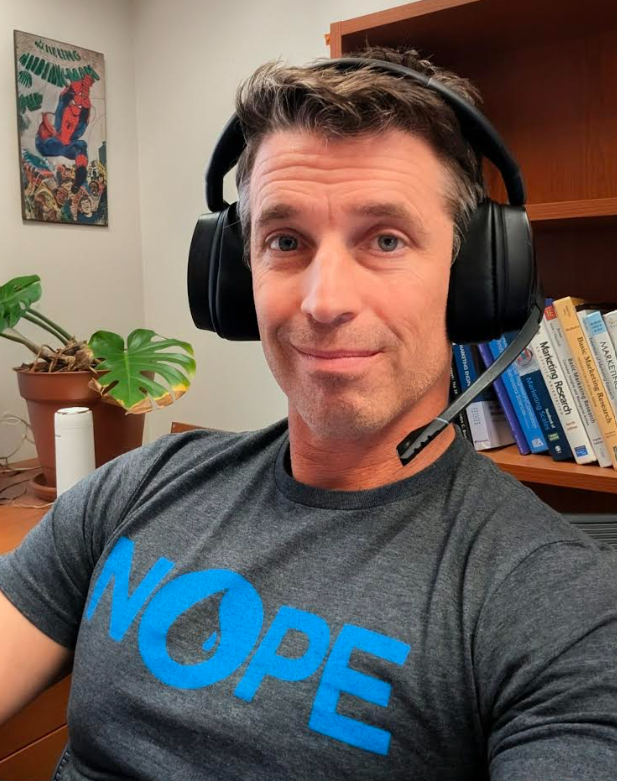
Dr. Andrew Baker
Associate Professor of Marketing · San Diego State University
Hands-on analytics tools, interactive readings, classroom games, and simulations built for marketing students—and anyone curious enough to dig into real data.
Get in Touch
I welcome questions, feedback, and inquiries from students, instructors, and institutions. Choose the contact channel or quick link below that best fits what you need:
Technical support, feature requests, bug reports, accessibility barriers, or general questions about using the platform.
Course adoption, sample course requests, institutional partnerships, academic collaboration, or instructor consultations.
Explore For Instructors or request a free instructor account.
Visit For Students or find the right method in the Tool Finder.
Review our Institutional Trust Center and Accessibility Statement.
I aim to respond to all emails within 2–3 business days. Thank you for your patience!
About MKTPraxis
I've been teaching marketing research and analytics at SDSU for close to 20 years. MKTPraxis exists because of a problem I kept running into—first as a student, now as a professor.
I was drawn to quantitative analysis early on, but I didn't come up through a traditional "quant" pathway. Marketing coursework was mostly qualitative, so it was hard to see where analytics actually fit. And when I tried learning quantitative methods on their own, they were buried in jargon with almost no connection to real marketing problems.
Over time I started working toward the middle: keeping the rigor of quantitative methods but grounding everything in practical marketing contexts. MKTPraxis is my attempt to make that space accessible—to help people develop intuition for how data behaves and how analytics can support better decisions.
A Bit About Me
I'm probably best described as a builder. I like making things—apps, tools, simulations, datasets—anything that makes abstract ideas more concrete. Most of what's on this site started as stuff I built for my own classes because I couldn't find what I wanted elsewhere.
I don't think most people learn analytics by reading about it. They learn by poking at things, breaking them, and seeing what changes. That's what I try to design for: curiosity, experimentation, and a healthy skepticism of "black box" answers.
Outside of work I gravitate toward the same kind of tinkering—3D printing, digital design, hardware, software, and generally figuring out how things work.
Why "Praxis"?
Fair question: what the heck does praxis even mean?
In philosophy and education, it refers to the loop of putting ideas into action—doing something, reflecting on it, and refining your understanding through experience.
But the term also carries weight from critical pedagogy, where praxis is about transforming knowledge, not just transmitting it. Learners actively construct understanding instead of passively receiving someone else's.
Both meanings matter here. I want tools that invite experimentation and reflection, not just execution—that's the pedagogical side. But I also believe analytical tools shouldn't be gatekept behind elite credentials, expensive software, or years of arcane training. With the right scaffolding, far more people can think critically with data than we typically assume. That's the emancipatory side.
MKTPraxis reflects both: learning by doing, guided by concepts, and open to anyone willing to engage. It's a statement about how I think marketing analytics should be learned—and who should get to learn it.
Purpose & Goals
Whether you're in a course or teaching yourself, these tools are designed to:
- Build intuition through interactive exploration and visualization
- Give immediate feedback so you learn from experimentation
- Connect concepts across statistics, ML, and marketing strategy
- Ground everything in practical marketing scenarios
- Support self-paced learning with tutorials and guided exercises
Today MKTPraxis includes 99 browser-based tools and 42 interactive reading modules, and is free for students and instructors—with no software to install. Instructors and institutions interested in using the platform in a course can request instructor access or reach out directly.